


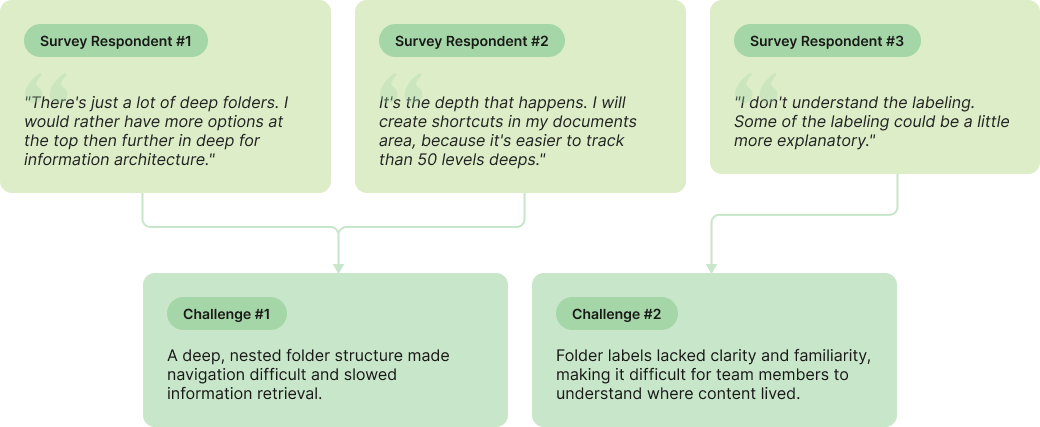

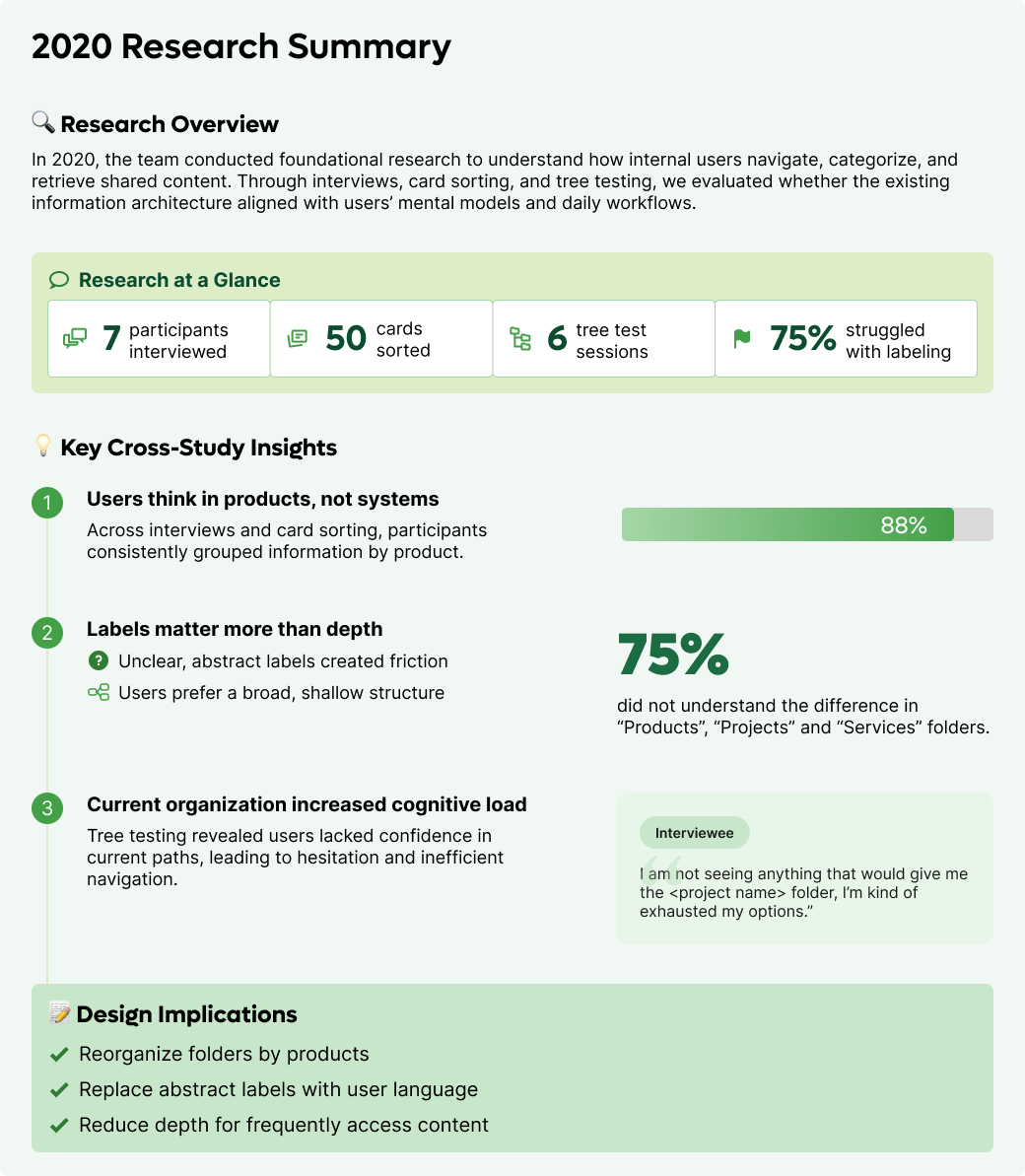
I reviewed research conducted in 2020 to establish a baseline understanding of user needs and pain points, saving time and resources while informing my own discovery studies.
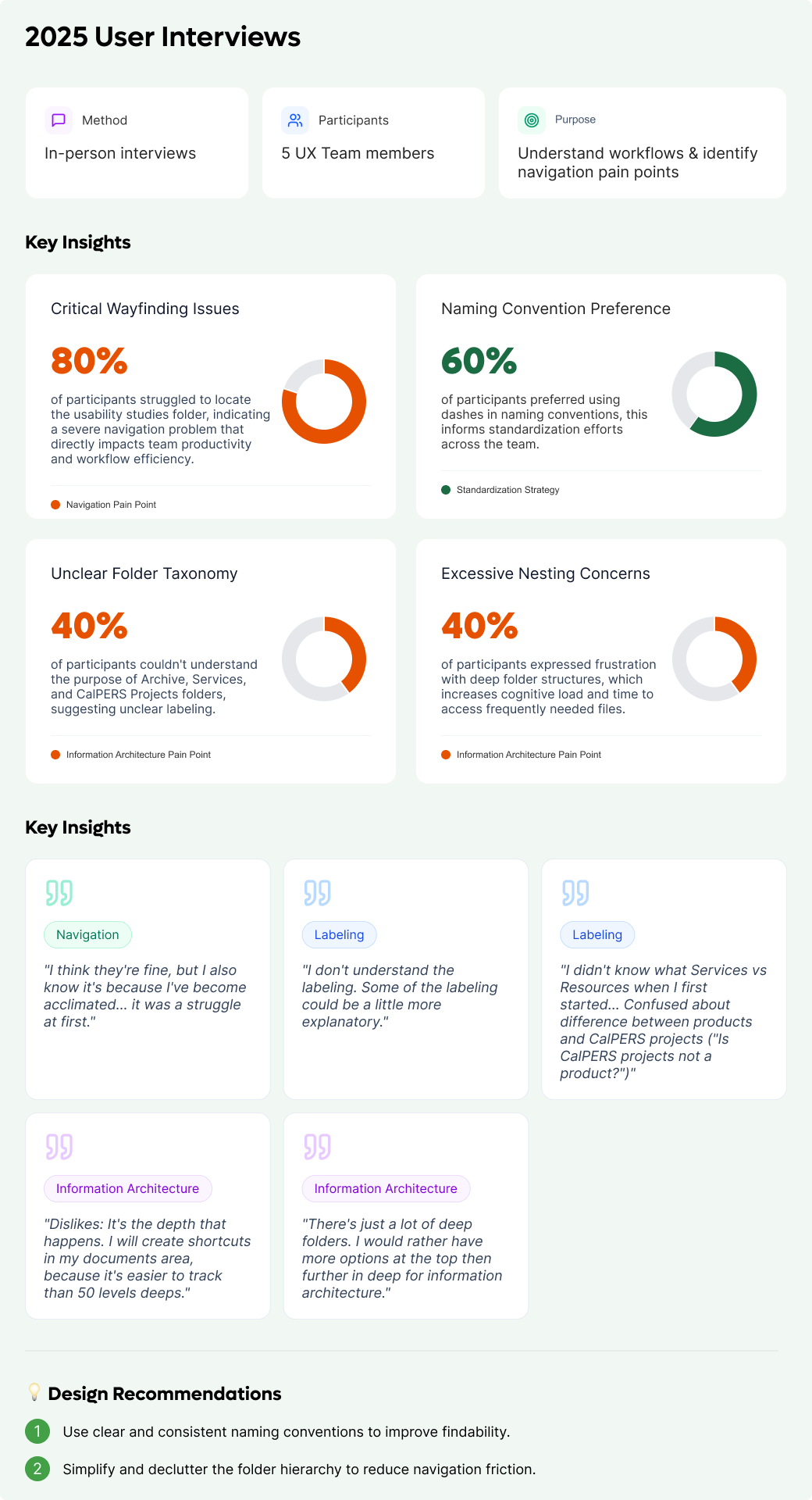
To validate findings from the 2020 research and understand how current team members organize and access shared content, I conducted interviews with 7 participants. These conversations revealed persistent pain points around labeling and folder structure, while also surfacing new insights about how the team's workflows have evolved since the original study.
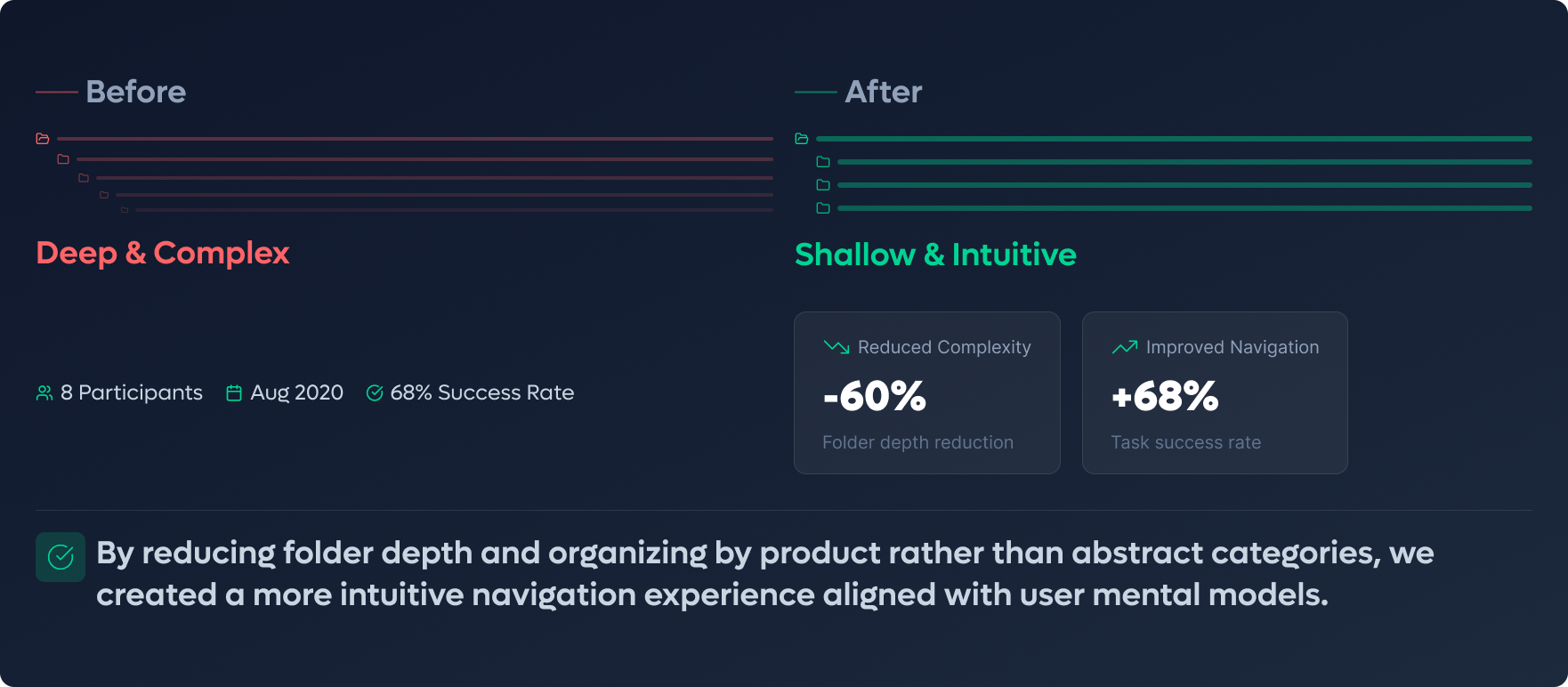
Informed by prior user research (2020) and validated through recent interviews and tree testing, I redesigned the F Drive information architecture around a product-based structure. Grouping content by product reduces folder depth and aligns with how team members naturally search for information.
To improve consistency and scalability, each product folder follows a standardized template, including dedicated Processes & Procedures and Usability Studies folders. This approach streamlines navigation, reduces time spent locating files, and supports faster onboarding for new team members.
Before implementation, I validated the proposed information architecture through tree testing on Optimal Workshop to assess its usability and intuitiveness.
This allowed me to identify last-minute friction, confirm that users could successfully locate information, and make targeted refinements to the structure prior to rollout.
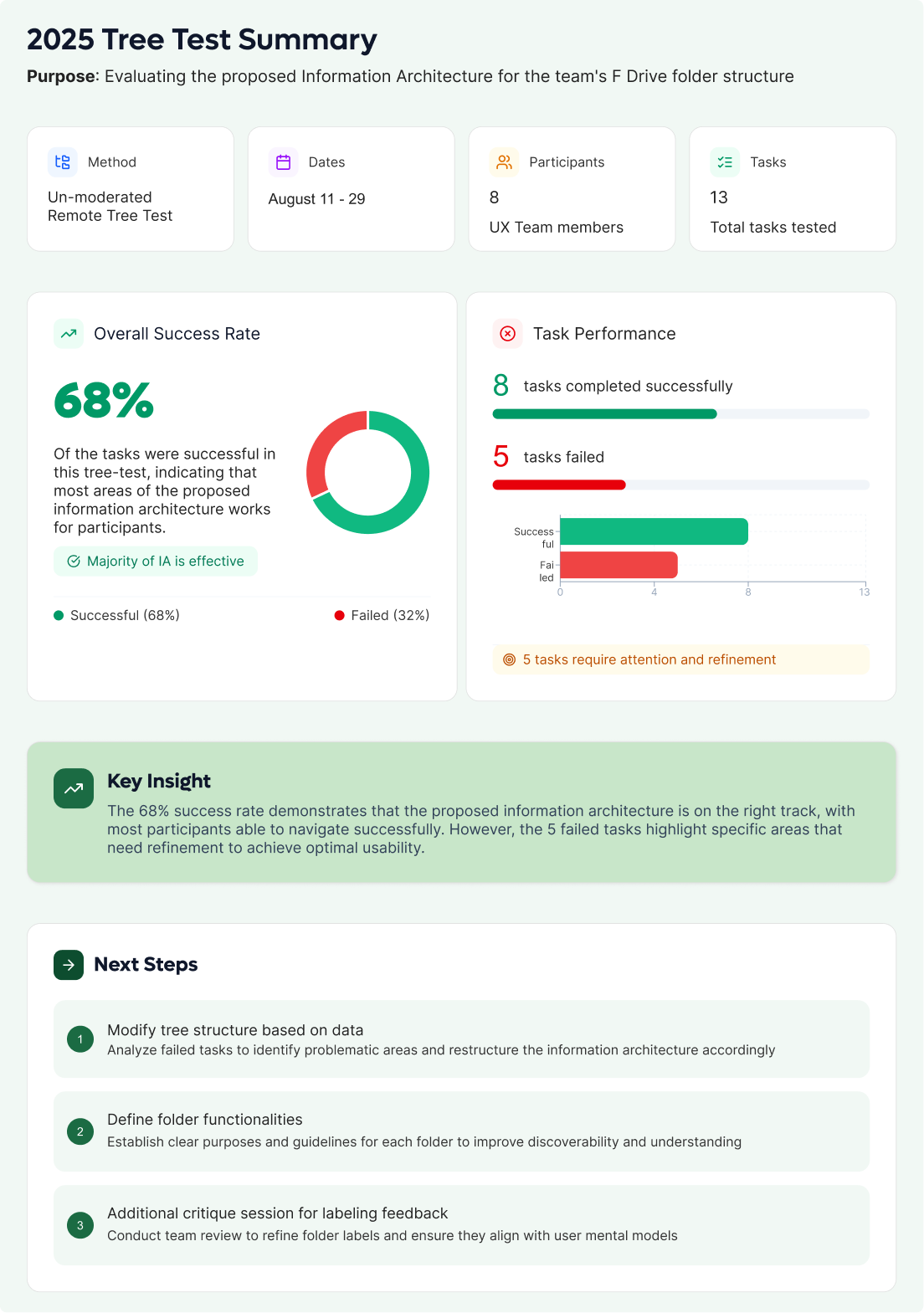
Based on strong task success in tree testing, I made targeted refinements to folder placement and labeling to address remaining points of confusion. I also facilitated a design critique to gather naming suggestions and align the team on a shared mental model, resulting in a finalized information architecture ready for adoption.
This initiative had been deprioritized since 2020 due to concerns about disrupting day-to-day workflows and limited perceived ROI. I learned how to advocate for structural UX work by grounding my recommendations in user interview insights and clearly articulating the risks of inaction.
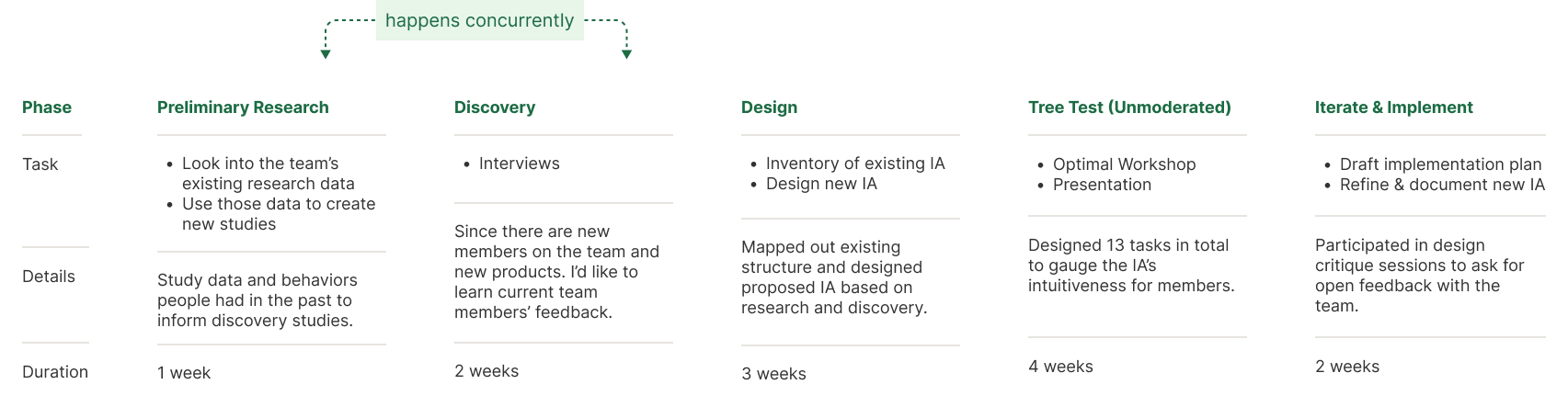
By presenting a defined, phased plan—from research through validation to implementation—I was able to reduce stakeholder hesitation, build confidence, and demonstrate that meaningful system improvements can be delivered with minimal operational disruption.
While this project focused on reorganizing a shared drive rather than designing a consumer-facing product, it strengthened my ability to untangle complex, deeply nested information systems. I learned how to evaluate and restructure information architecture to improve usability, findability, and intuitiveness—skills that directly translate to site navigation, product ecosystems, and content-heavy platforms.
To evaluate the effectiveness of the new information architecture, I would conduct a follow-up usability assessment after six months of adoption. This would include a short survey and task-based validation to measure improvements in findability, confidence in navigation, and overall satisfaction. Insights from this evaluation would inform iterative refinements to the folder structure as usage patterns evolve.
